For years, I was curious about the Char Dham of Uttarakhand, not merely as a pilgrimage but as a journey into the Himalaya where faith, rivers, forests and stone seem to share one language. I began planning slowly, studying the route and seasons, yet the real attraction was simpler: I wanted to travel through these mountains at human pace, listen to local voices, and discover what lies beyond the temples.
Char Dham is not a city but a sacred Himalayan circuit of four shrines—Yamunotri, Gangotri, Kedarnath and Badrinath—spread across Uttarakhand’s Garhwal region. Traditionally, the journey moves from west to east, beginning at Yamunotri, continuing to Gangotri, then Kedarnath and ending at Badrinath. On the map it looks like a demanding mountain itinerary; on the ground, it feels like four distinct worlds connected by rivers, valleys and devotion.
The history of Char Dham is woven from spiritual scriptures, pilgrimage traditions and centuries of Himalayan worship. Yamunotri honors Goddess Yamuna, Gangotri Goddess Ganga, Kedarnath Lord Shiva and Badrinath Lord Vishnu. Badrinath is traditionally associated with Adi Shankaracharya’s revival of the shrine in the eighth century, while Kedarnath carries ancient Shaiva traditions and Mahabharata legends. These stories are not museum pieces here; they remain part of everyday conversation.
Geographically, the circuit rises deep into the Garhwal Himalaya, where altitude changes quickly and weather can turn within hours. Yamunotri lies around 3,233 meters, Gangotri about 3,400 meters, Kedarnath around 3,580 meters and Badrinath around 3,100 meters. Summers are comparatively cool, monsoon brings rain and a landslide risk, while autumn offers crisp skies. Winter snow closes the high shrines, shifting worship to their lower winter seats.
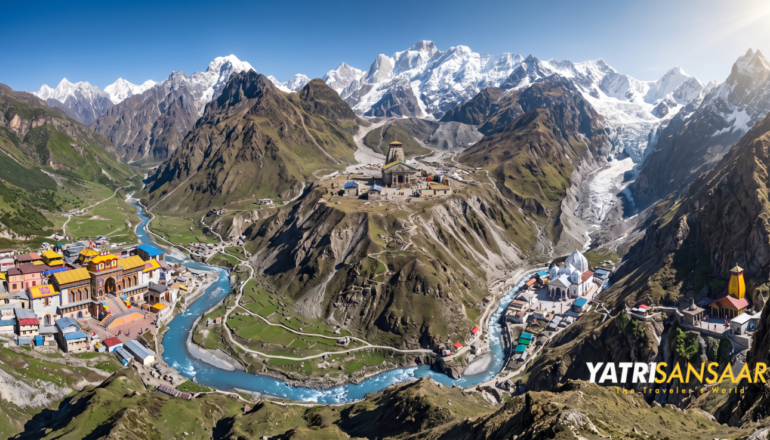
What stayed with me most was the landscape between destinations. Near Yamunotri, the Yamuna valley feels narrow and dramatic; Gangotri opens toward deodar forests, glaciers and the Bhagirathi; Kedarnath stands beneath an immense amphitheater of peaks; Badrinath rests beside the Alaknanda between the Nar and Narayana ranges. At sunrise, the mountains change colour so quietly that you almost forget to take out your camera.
I found the local culture most vividly in roadside tea stalls, guesthouses, temple markets and village homes rather than formal attractions. Residents live with a practical rhythm shaped by altitude, pilgrimage seasons and weather. Woolens, mountain houses, bells, chants and hospitality define the atmosphere. In local kitchens, try aloo ke gutke, mandua roti, jhangore ki kheer, pahadi dal and seasonal vegetables; food here tastes better after a mountain journey.
Yamunotri is where the pilgrimage became physically real for me. The road reaches Janki Chatti, after which the final approach requires walking, or using a pony, palanquin or permitted local assistance. The trail climbs beside mountain scenery toward the temple and sacred hot springs. I learned quickly that this is not a place for rushing; steady steps, water breaks and respect for other pilgrims make the experience far more rewarding.
From Yamunotri, the road journey toward Gangotri passes through Uttarkashi and remarkable Himalayan valleys, with Harsil offering one of the most memorable pauses. Gangotri itself sits beside the Bhagirathi and feels quieter than its reputation suggests outside peak pilgrimage hours. For adventurous travellers, Gaumukh lies farther ahead through Gangotri National Park, but trekking there requires planning and the necessary permissions. Even a slow riverside walk can be deeply satisfying.
Kedarnath changed the character of my journey completely. The final approach is not a conventional road trip: travellers reach the road head at Sonprayag and continue toward the shrine by trekking or approved alternatives, depending on current arrangements. The temple, at high altitude, stands against an extraordinary mountain backdrop. I remember the silence after the crowds thinned—the sound of the Mandakini and distant bells making the valley feel almost timeless.
Badrinath felt different again, more settled and expansive after the intensity of Kedarnath. The Badrinarayan Temple stands beside the Alaknanda, framed by the Nar and Narayana Mountains, while nearby places such as Mana village; Tapt Kund and Vasudhara add depth to the visit. I would keep time here for walking, sitting quietly beside the river and observing pilgrims rather than treating Badrinath as merely the final checkbox.
Reaching Char Dham is part of the experience itself. For most travellers, Haridwar, Rishikesh or Dehradun works as a practical gateway, with road journeys continuing through Uttarakhand’s mountain towns. Haridwar and Rishikesh are major rail gateways, while Jolly Grant Airport near Dehradun is the principal air access for the region. From the gateways, buses, shared vehicles, taxis and private cars connect the pilgrimage corridor, subject to weather and road conditions.
Local transport becomes increasingly limited as altitude rises. State buses and shared jeeps are useful between larger settlements, while taxis provide greater flexibility for families. At Yamunotri and Kedarnath, the last stretches involve trekking and regulated local services instead of ordinary road travel. Helicopter services may operate on selected sectors, but schedules, weather and operational rules can change. I always treat mountain transport as flexible, never as a fixed promise.
My strongest travel advice is to plan with margin. Complete the required Char Dham registration before departure, check official weather and route updates, carry layered clothing, sturdy footwear, rain protection, medicines and water, and avoid packing beyond necessity. Begin walking early, acclimatize gradually and never underestimate altitude or mountain weather. Keep cash for smaller settlements, protect the environment, follow temple rules and leave extra time for traffic, landslides or delays. When I thought the journey was over, I knew Char Dham had changed the way I travel. It is not merely Yamunotri, Gangotri, Kedarnath and Badrinath placed into an itinerary; it is the road between them—the river beside the window, a porter climbing patiently, tea steaming in cold air and a stranger offering directions. If you seek mountains with memory and faith with landscape, Char Dham is waiting.