There are journeys that take you somewhere
And then there are journeys that take you away from everything familiar—only to bring you closer to yourself.
My journey to Dhamma Bodhi at Bodhgaya belonged to the second kind.
I had heard about Vipassana long before I seriously considered experiencing it. Ten days of silence. Hours of meditation. No phone. No books. No casual conversations. No entertainment. Just breath, body, mind—and an uncomfortable amount of time alone with one’s own thoughts.
At first, the idea sounded almost impossible.
Why would anyone willingly give up the very things modern life encourages us to hold on to so tightly?
The more I read, however, the more curious I became. Vipassana, as taught in the tradition of S. N. Goenka, is built around direct observation rather than intellectual speculation. One begins with awareness of natural breathing and gradually develops awareness of bodily sensations, learning to observe experience without immediately reacting to it.
It sounded simple. It wasn’t.
And perhaps that was precisely why I needed to experience it.
So I decided to travel to Bodhgaya- not merely as a traveler visiting one of Buddhism’s most sacred destinations, but as a Saadhak, a practitioner willing to turn inward and see what might emerge when the noise of everyday life was deliberately switched off.
I took a morning flight to Gaya with surprisingly little luggage. Physically, I was travelling light but Mentally, I was carrying considerably more.
The journey from Gaya towards Bodhgaya gradually brought back the familiar rhythm of the pilgrimage town— roads, vehicles, people, shops, pilgrims and the unmistakable energy that surrounds one of the world’s most important Buddhist destinations.
Yet I knew that my destination was not another monument to photograph.
I was going to Dhamma Bodhi.
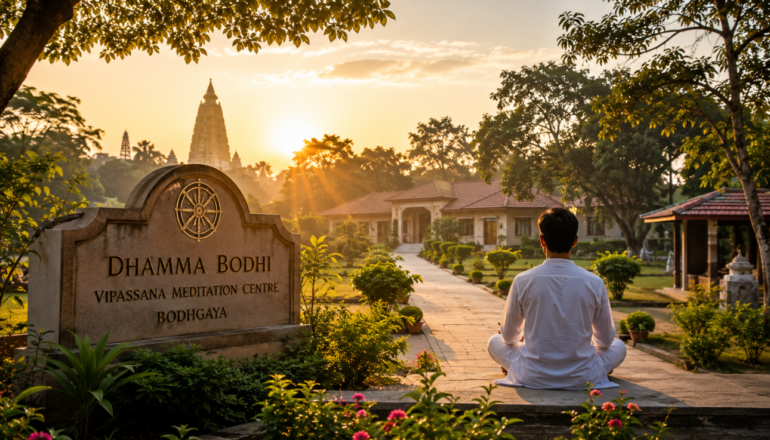
Located on Gaya-Dobhi Road, next to IIM Bodhgaya, the centre seemed close enough to the bustle of Bodhgaya, yet psychologically it felt like another world.
The final approach can be made by auto-rickshaw, cycle-rickshaw, taxi or private vehicle. But there is something I would recommend to anyone coming for a Vipassana course:
Don’t arrive in a hurry.
The journey to Dhamma Bodhi is not merely a transfer from one place to another. It is, in a small way, the beginning of a change in rhythm.
The first thing I noticed after entering Dhamma Bodhi was not a spiritual revelation.
It was the silence.
Outside, Bodhgaya had been alive with movement—vehicles, voices, pilgrims, shops and the ordinary sounds of a busy Indian town.
Inside the centre, the atmosphere was strikingly different.
Quiet.
Uncluttered.
Almost disarming.
I met fellow participants from remarkably different parts of the world and India—Israel, Argentina, Germany, the United States, Assam, Maharashtra and elsewhere. Some were first-timers. Others had already experienced Vipassana and had returned.
Yet despite our different languages, cultures, professions and personal histories, we appeared to share one common emotion:
nervousness.
We smiled. We exchanged brief introductions.
We spoke about the course, the discipline and what we imagined the next ten days might be like.
We did not know it then, but those casual conversations were going to be our last ordinary conversations for quite some time.
Soon, Noble Silence would begin and the real journey would start. My first evening at Dhamma Bodhi corrected one of my assumptions that this was not a wellness holiday.
There was no program designed to entertain me, no luxurious schedule created for comfort and no collection of activities intended to keep the mind occupied.
The discipline was the experience.
A standard ten-day course begins on the evening of arrival and concludes on the morning of the final day. Participants are expected to apply beforehand, understand the technique and carefully read the Code of Discipline.
Everything has a purpose.
The structure creates an environment in which the mind can gradually stop depending on its usual distractions and begin observing itself.
The daily schedule was demanding.
Wake up at 4:00 a.m.
Meditate.
Eat simple vegetarian food.
Meditate again.
And again.
And again.
Nearly ten hours of meditation formed the backbone of the day.
There were no phones, books, journals or casual social interactions. Even eye contact was avoided.
For a traveler accustomed to movement, communication, planning and constant stimulation, this was an entirely different landscape.
And by the third day, my mind had begun to protest.
Loudly.
Silence sounds peaceful from the outside.
Inside, it can be surprisingly noisy.
Once conversation disappeared, I began noticing how much activity normally takes place inside the mind.
Thoughts about work appeared.
Then family.
Then travel.
Then unfinished tasks.
Then memories I had not consciously invited.
Then plans for the future.
The mind seemed determined to remind me of everything except the present moment.
Vipassana did not ask me to suppress those thoughts.
It asked me to observe.
That distinction gradually became important.
Instead of fighting thoughts, the practice encouraged awareness and equanimity— learning to see sensations and mental activity without immediately becoming entangled in them.
For someone used to reacting quickly, this was harder than it sounds. Around me, other Saadhaks were undergoing their own private journeys.
Some were young.
Some were older.
Some looked exhausted.
Some smiled.
Some occasionally appeared lost in thought.
No one knew exactly what was happening inside anyone else’s mind.
And yet, in that shared silence, there was an unexpected sense of companionship.
We were alone together.
That may sound contradictory.
It wasn’t.
Everyone was walking an invisible inward path, and although no one could see another person’s journey, there was a quiet recognition that we were all facing something similar.
Our external identities gradually became less important.
Profession.
Nationality.
Social position.
Travel history.
None of it mattered much inside the meditation hall.
There was simply the practice.
And the person sitting with it.
The turning point for me came gradually.
There was no dramatic vision.
No sudden mystical experience.
No cinematic moment of enlightenment.
Instead, something much subtler began to happen.
Physical discomfort that had initially triggered irritation slowly became something I could observe.
A sensation appeared.
It changed.
It remained for a while.
Then it disappeared.
The experience itself became a lesson in impermanence.
Old memories surfaced unexpectedly. Rather than chasing them or pushing them away, I began learning to acknowledge them and let them pass.
Around me, I noticed similar changes.
Faces that had appeared tense during the first few days seemed softer.
Shoulders relaxed.
The nervousness that many of us had carried through the gates seemed gradually to lose its grip.
The simplicity of the technique became increasingly striking.
There were no elaborate rituals.
Nothing complicated to visualize.
The practice began with something extraordinarily ordinary:
breathing.
The natural breath.
Something happening every second of our lives, usually without our attention.
From there, awareness gradually moved towards bodily sensations.
The challenge was not understanding the instructions.
The challenge was remaining patient.
To experience something pleasant without clinging to it.
To experience something unpleasant without immediately resisting it.
To observe rather than react.
That became one of the most valuable lessons I carried away.
By the middle of the course, I began to understand that silence was not merely the absence of speech.
It was an opportunity to hear what ordinary life keeps buried beneath constant activity.
When we are surrounded by people, screens, conversations, responsibilities and entertainment, the mind rarely gets the opportunity to reveal its quieter layers.
At Dhamma Bodhi, those distractions were gradually removed.
What remained was not always comfortable.
But it was honest.
There were thoughts I would rather not have.
Memories I had forgotten.
Expectations I had carried without examining.
Restlessness I had mistaken for productivity.
And beneath all of it was something surprisingly simple—the possibility of observing without immediately reacting.
Perhaps this is where the real work of Vipassana begins.
Not in escaping the mind.
But in finally looking at it.
When Noble Silence eventually ended, conversations suddenly felt almost strange.
After days of communicating without words, ordinary speech seemed to carry a different weight.
Fellow practitioners began sharing why they had come.
One wanted greater mental discipline.
Another had been searching for quiet after years of professional pressure.
Someone else had returned because a previous course had changed the way he responded to difficult situations.
Their reasons were different.
Their stories were different.
Yet beneath those differences were remarkably similar questions.
Why do we become restless?
Why do we cling?
Why do we fear?
Why do we desire?
Why do certain experiences control our reactions?
And is it possible to live with greater balance?
Perhaps that is one of the remarkable things about Vipassana.
People arrive through different doors.
But eventually, many find themselves sitting before similar questions.
When my ten days at Dhamma Bodhi finally came to an end, I walked out feeling strangely different.
The world had not changed.
I had.
The sounds of Bodhgaya seemed louder than before.
Trains clattered.
Rickshaws honked.
Pilgrims chanted.
People hurried along the roads.
Life had resumed its familiar rhythm.
Yet somewhere within me, another rhythm had become noticeable.
A quieter one.
A patient one.
An observer seemed to remain seated inside me, watching without immediately grasping or resisting.
That, I realised, was perhaps the real souvenir of Dhamma Bodhi.
Not something I could put in a suitcase.
Not something I could photograph.
Not something I could show anyone.
But something I could carry.
Bodhgaya already occupies a unique place in the spiritual imagination of millions.
The Mahabodhi Temple and the sacred Bodhi Tree provide an extraordinary historical and spiritual context to any journey here.
But Dhamma Bodhi belongs to a different rhythm.
Outside are pilgrims, monasteries, prayer flags, vehicles and the colorful movement of a pilgrimage town.
Inside, the direction of travel changes.
You stop moving outward.
You begin moving inward.
That difference is important.
Dhamma Bodhi should not be treated simply as another attraction to be inserted between visits to temples and monasteries.
A Vipassana course asks for something very different from sightseeing.
It asks for time.
Discipline.
Patience.
Silence.
And, perhaps most importantly, willingness.
If curiosity has brought you this far, take it seriously.
But prepare for the experience rather than simply preparing your luggage.
Apply through the official course schedule and wait for confirmation before making rigid travel arrangements. Read the Code of Discipline carefully and understand what the ten days will require.
Tell your family and close contacts beforehand that you will be unreachable.
Complete urgent professional commitments.
Arrive with sufficient time before reporting.
If possible, avoid turning the journey into a rushed race from airport or railway station straight into the meditation hall.
A calm arrival makes a difference.
Pack modest, comfortable clothing suited to the season. Bihar can be warm, while winters require warmer clothing. Carry essential personal medication if required and keep your belongings practical and minimal.
Most importantly, do not arrive expecting to continue your normal lifestyle inside a meditation course.
You have to temporarily surrender your normal routine rather than trying to squeeze meditation into it.
The timing of your journey deserves attention. Bodhgaya can become particularly busy during pilgrimage seasons and major Buddhist occasions. Give yourself a reasonable buffer between arrival and the reporting time specified by the centre.
Do not assume that every course will have vacancies.
Course schedules and admission status can change, so check the current Dhamma Bodhi schedule before confirming flights, trains or other arrangements.
The centre operates on Dana, or voluntary donation. Course participants are not charged a course fee.
This simplicity is itself part of what makes the experience unusual.
I arrived at Dhamma Bodhi expecting answers.
I left with better questions.
That may sound like a small difference.
For me, it wasn’t.
I had imagined that Vipassana might produce some spectacular moment that would divide life neatly into a ‘before’ and ‘after.’
Instead, the change was quieter.
It happened through repeated observation.
One breath.
One sensation.
One reaction noticed.
One reaction not followed.
Again and again.
Until, somewhere along the way, I began to see that the real practice was not confined to the meditation cushion.
It was about the way one meets experience.
Pleasant or unpleasant.
Comfortable or uncomfortable.
Expected or unexpected.
The invitation was always the same:
Observe. Understand. Don’t immediately react.
Looking back, I realize that my most memorable experience at Dhamma Bodhi was not a particular meditation session.
It was the gradual discovery of what silence makes visible.
When the outside world becomes quiet, the inner world becomes easier to hear.
And when one listens long enough, perhaps one begins to recognize something that was present all along.
Bodhgaya is known around the world as a landscape of awakening.
Millions come here to stand before the Mahabodhi Temple, sit beneath the Bodhi Tree, offer prayers and feel connected to an extraordinary chapter in human spiritual history.
But there is another way to encounter Bodhgaya.
A quieter way.
At Dhamma Bodhi, the journey is not measured in kilometers.
It is measured in breaths.
In sensations.
In moments of awareness.
In the gradual space between what happens and how we choose to respond.
You arrive carrying the noise of the outside world.
For ten days, you sit with silence.
And eventually, you walk back into that same world carrying something different.
Not an answer.
Not a souvenir.
Not a dramatic revelation.
Just a little more awareness.
A little more equanimity.
And perhaps a quieter understanding of yourself.
That is what Vipassana at Dhamma Bodhi gave me.
A doorway into myself—one breath, one step, one silent moment at a time.